Why Petrochemical Facilities Are Considering Additive Manufacturing
The petrochemical and oil & gas sector is one of the most demanding in terms of equipment operating conditions. Aggressive chemical environments, elevated temperatures, and rigorous maintenance schedules create a specific set of challenges where industrial 3D printing can help.
This does not concern parts operating in direct contact with hydrocarbons in hazardous zones. The relevant application space covers workshops and laboratories, auxiliary equipment, maintenance tooling, pipeline component prototyping, and fabrication of service parts. This is where additive technologies enable consideration of significant reductions in lead times and costs.
The conventional cycle for fabricating even a simple maintenance fixture — requisition, approval, order placement, delivery — can take weeks. For remote sites (oil fields, offshore platforms, remote refineries), logistics compounds the problem: shipping specialized tooling or non-standard spare parts often costs as much as the part itself.
An industrial 3D printer deployed in the facility's maintenance workshop or laboratory enables a different workflow: digital model, print from engineering polymer, part on-site. This is particularly relevant for organizations operating across distributed sites, where supply chain disruptions and extended procurement cycles create additional downtime risk.
Typical Applications for 3D Printing in Petrochemical Operations
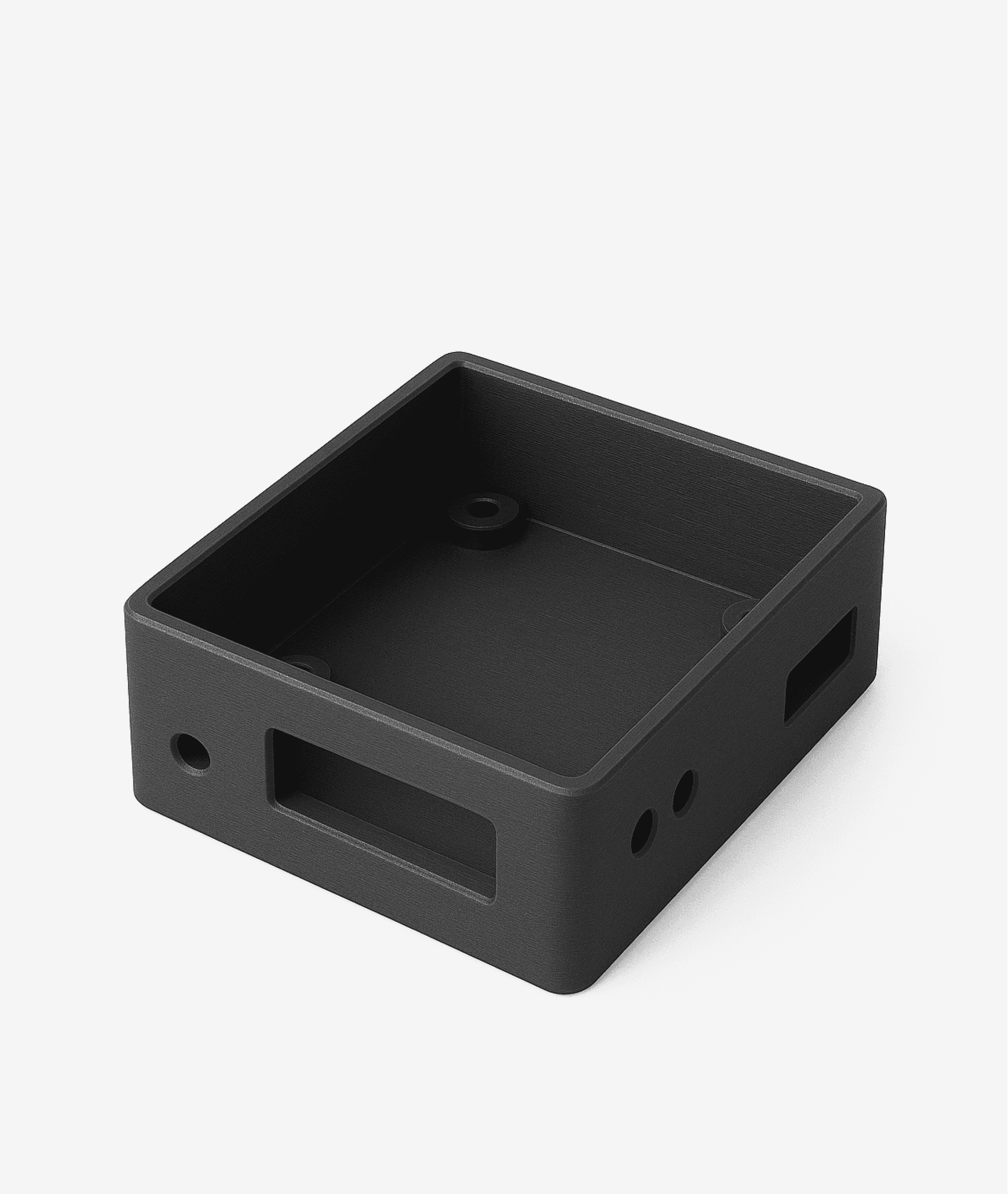
Chemically resistant fixtures and housings. Mounting brackets, protective covers, sensor housings, and electronics enclosures for laboratories and workshops. Printing from PEEK provides resistance to a broad spectrum of chemical environments.
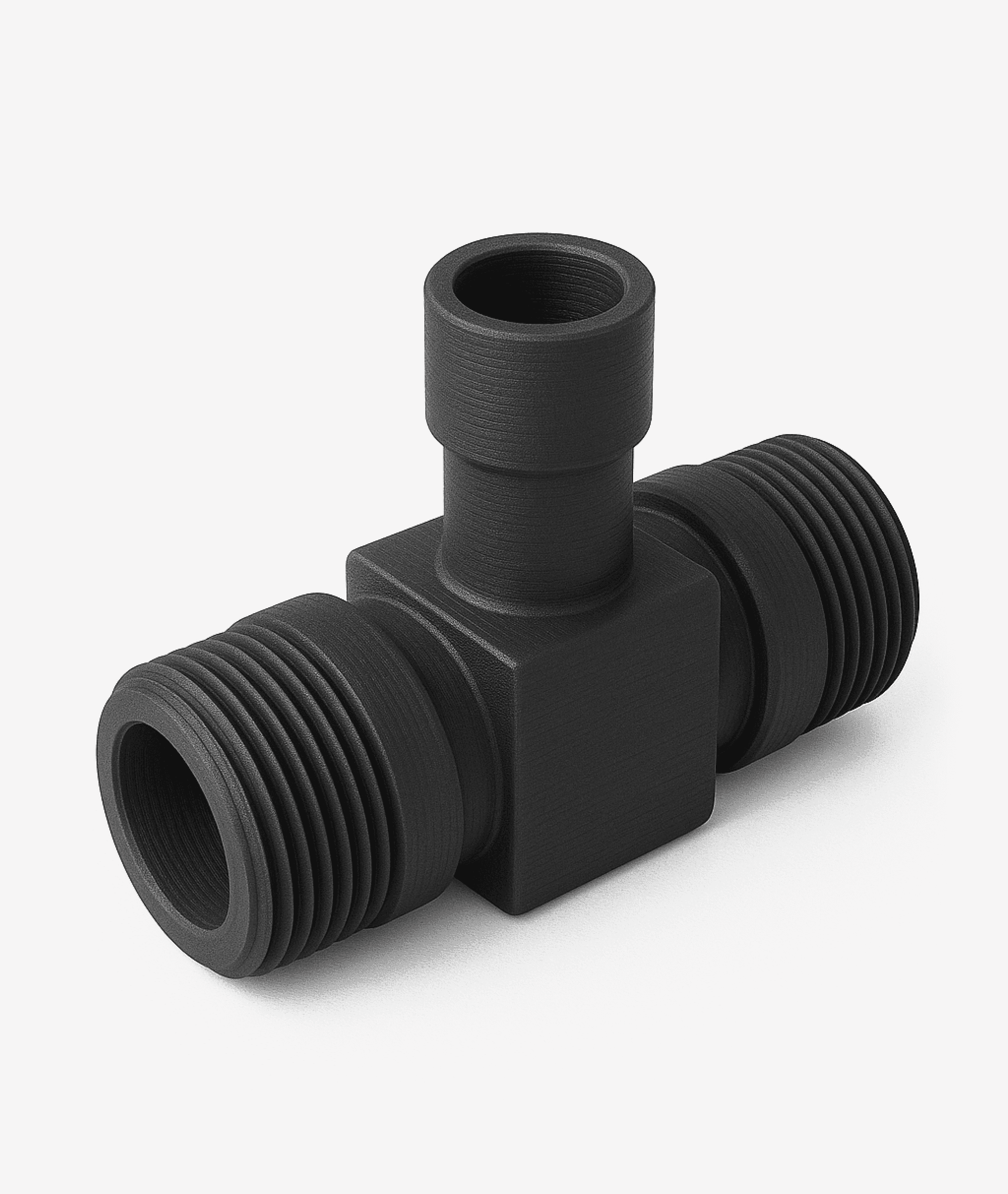
Pipeline component prototypes. Verifying geometry, fit, and compatibility of flange connections, tees, reducers, and adapters before ordering serial production from metal.
Valve and fitting prototypes. Full-scale models for checking layout, serviceability access, and pipe routing. The CD400HT positioning accuracy (XY 5 microns, Z 2 microns) enables detailed geometry validation.
Specialized tool holders. Custom cradles for wrenches, gauges, and instrumentation, adapted to specific workstations.
Laboratory equipment fixtures. Holders, clamps, and adapters for analytical and testing equipment. Small batches and one-off items that are not economical to source from external suppliers.
Protective covers and guards. Cable entry housings, instrument panel covers, rotating equipment guards for auxiliary systems.
Maintenance fixtures and alignment jigs. Centering sleeves, assembly templates, alignment fixtures — anything that accelerates scheduled and unscheduled maintenance turnarounds.
Important: Scope of 3D printing in petrochemical applications
3D-printed polymer parts are intended for workshops, laboratories, and non-hazardous areas
Applications: prototyping, auxiliary tooling, maintenance equipment, auxiliary system spare parts
An engineering assessment of operating conditions is recommended for each specific case
The printer does not carry ATEX certification — deployment in safe zones only
Production Application Scenarios
01
Chemically resistant fixture from PEEK
A refinery analytical laboratory requires a specialized sample holder that will contact aggressive solvents. Standard polymer fixtures degrade within months. The part is printed from PEEK on the CD400HT: the 150 deg C chamber enables controlled crystallization, and the material itself resists most organic solvents and acids. The result is a fixture designed for sustained operation in a chemically aggressive environment.
02
Pipeline fitting prototype
The project engineering team is developing a custom adapter for a pipeline section upgrade. Before ordering the cast metal version, they need to verify geometry, flange compatibility, and installation access. A full-scale prototype is printed from PA-CF on the CD400HT: the 350x350x400 mm build volume is typically sufficient for most pipeline elements from DN50 to DN200. Two to three design iterations in a week — instead of one per month when fabricating from metal.
03
Maintenance tooling for refinery equipment
During a planned shutdown, a guide bushing on an auxiliary pump needs replacement. The original part is imported, with a 6-8 week lead time. The part is modeled from measurements or a 3D scan, then printed from PC-ABS. The pump is returned to service within a day. The digital model is stored in ProtypeHub — the next time it is needed, the part is reproduced without redesign.
04
Housings for laboratory instrumentation
The quality control laboratory needs a series of custom housings for temperature and pressure sensors in test rigs. The batch size is 15 units, making injection mold tooling uneconomical. The housings are printed from PEEK on the CD400HT: IDEX Copy mode enables producing two housings simultaneously, the material's operating temperature is sufficient for the test rig conditions, and PEEK's chemical resistance provides long service life.
Want to evaluate how 3D printing can support your facility's operations?
Reduced supply chain dependency. For facilities operating across global supply chains, a common challenge is that auxiliary components are sourced exclusively from distant suppliers. On-site 3D printing from engineering polymers can help address a portion of the demand for non-standard parts — especially for auxiliary and laboratory equipment.
Faster maintenance turnarounds. Every day of process unit downtime represents lost production. Tooling and fixtures printed on demand enable consideration of shorter turnaround windows: the part can be ready before the maintenance window begins, rather than arriving partway through.
Rapid prototyping. Verifying the geometry of pipeline components, valves, and fittings before ordering metal fabrication can help avoid costly errors at the manufacturing stage.
Digital spare parts inventory. Storing parts as digital files instead of physical warehouse stock. This is especially relevant for equipment that has been discontinued or for legacy imported components that are no longer readily available.
3D Printing and Artificial Intelligence: Practical Applications in Petrochemical Operations
Integrating additive technologies with AI tools opens additional possibilities for petrochemical facilities. Some approaches are already being applied in practice; others are at the pilot project stage.
Predictive maintenance and print-ahead workflows. Neural network models trained on vibration monitoring data, thermography, and failure histories can help predict the wear of specific components. Coupled with a 3D printer, this enables consideration of a "print before failure" approach: a replacement part from PEEK or PA-CF is fabricated proactively and ready for the next planned shutdown.
Digital twins and prototyping. A digital twin of a process unit contains a precise 3D model of every component. When upgrading or replacing a pipeline section, the digital model of the new element can be exported directly to the printer for geometry verification. This can help reduce installation errors.
Automated part identification for legacy equipment. Computer vision algorithms trained on parts databases can help identify a worn component from a photograph or 3D scan, match it to the nearest analog in a digital model library, and prepare the file for printing. This is particularly relevant for older equipment where original documentation has been lost.
Print parameter optimization for specific environments. Machine learning algorithms can select print settings (chamber temperature, speed, orientation, infill pattern) based on the specific operating conditions of the part — chemical environment, temperature range, mechanical loads. This enables more predictable part behavior in real-world conditions.
Why the Protype CD400HT Is the Primary System for Petrochemical Applications
PEEK and super-polymers. The CD400HT is the model in the range that provides full capability for printing PEEK, PEKK, and ULTEM. Chamber up to 150 deg C with uniformity of Delta-T less than 1 deg C, build plate up to 250 deg C, hotend up to 550 deg C — the parameters required for controlled crystallization of super-polymers. PEEK combines chemical resistance, continuous service temperature up to 250 deg C, and high mechanical strength — properties that are critical for petrochemical operating conditions.
Large-format printing. The 350x350x400 mm build volume enables consideration of printing full-scale pipeline component prototypes, housings, and protective covers without segmentation.
Precision for fittings and valves. XY positioning 5 microns, Z positioning 2 microns. Layer thickness from 0.05 mm. This provides the geometric accuracy needed for valve, fitting, and flange connection prototypes where deviations of tenths of a millimeter are significant.
Production autonomy. IDEX — two independent extruders. Copy and Mirror modes double output. Auto-feed filament system 4x3 kg supports unattended operation for over 10 days. Built-in drying chambers 2x130 deg C keep moisture-sensitive materials (especially PA-CF) in optimal condition. Print speed up to 300 mm/s.
CD400 for general-purpose tooling. For tasks that do not require super-polymers — maintenance fixtures from PC-ABS, prototypes from PA-CF, protective covers from ABS — the CD400 offers a larger 400x400x400 mm build volume and chamber up to 90 deg C. Both printers are managed through the shared ProtypeOS + ProtypeHub + Secure VPN ecosystem.
CD400 vs. CD400HT Comparison
Parameter
CD400
CD400HT
Build volume
400x400x400 mm
350x350x400 mm
Chamber temperature
up to 90 °C
up to 150 °C (ΔT < 1 °C)
Build plate temperature
up to 150 °C
up to 250 °C
Hotend temperature
up to 550 °C
up to 550 °C
Drying chambers
2x up to 80 °C
2x up to 130 °C
Key materials
PA-CF, PC-ABS, ABS, PA6, TPU
PEEK, PEKK, ULTEM + all CD400 materials
Petrochemical focus
Tooling, maintenance parts, covers
Chemical-resistant parts, fitting prototypes
Warranty
12 months
12 months
Try & Buy: 3-month evaluation program
Protype offers a Try & Buy program: use the printer in your production environment for 3 months, and if you purchase, 100% of the rental cost is credited toward the purchase price. For petrochemical facilities, this provides an opportunity to evaluate real-world applicability on actual production tasks without financial risk.
Frequently Asked Questions
Ready to evaluate 3D printing for your petrochemical operations?
Take advantage of the Try & Buy program: 3 months of on-site evaluation with 100% rental credit toward purchase.
We integrate Protype into production cycles across industries—from Education to Aerospace
Where Protype printers already work
01
Mechanical engineering
Applications
Jigs, gearboxes, brackets.
Why it's worth it
Tooling in hours, not weeks. Small-batch costs drop 5–10x while accuracy stays the same.
02
Architecture
Applications
Building models, facades, landscapes.
Why it's worth it
Clients see a physical model before ground is broken — approvals happen faster.
03
Railway
Applications
Fasteners, sensor housings, cable channels.
Why it's worth it
The railcar doesn't sit idle while the part ships from a warehouse. Print on-site — minimal downtime.
04
Medical
Applications
Orthoses, prosthetics, anatomical models.
Why it's worth it
Every piece fits the patient's anatomy exactly. No molds needed, ready in a day.
05
Education & R&D
Applications
Fixtures, gears, trays.
Why it's worth it
A failed prototype isn't a setback — it's the next iteration. A new one prints in an hour.
06
Aerospace
Applications
Covers, ducts, fasteners.
Why it's worth it
Lighter part, more complex geometry — and still ready overnight instead of a month on the mill.
07
Shipbuilding
Applications
Supports, gaskets, small hardware.
Why it's worth it
The yard doesn't wait on a supplier — parts print right in the dock, repairs stay on schedule.
08
Instrumentation
Applications
Enclosures, covers, PCB holders.
Why it's worth it
Changed the PCB layout? Reprint the enclosure. No retooling, no missed deadlines.
Don't see your industry?
Tell us what your facility produces — we'll find a solution to cut costs and speed up part production
Mechanical engineering
Applications
Jigs, gearboxes, brackets.
We print tooling and structural elements for assembly and repair: positioning jigs, gearbox housings, fixtures. This speeds up new line launches and allows quick reconfiguration of assemblies.
Why it's worth it
Tooling in hours, not weeks. Small-batch costs drop 5–10x while accuracy stays the same.
Don't see your industry?
Tell us what your facility produces — we'll find a solution to cut costs and speed up part production
We'll calculate the savingsfrom 3D printingfor your production
We'll evaluate your parts, compare with your current method, and show where 3D printing is more cost-effective.